 One of my first intentional “to-dos” this year has been spending time with the World Economic Forum’s Global Cybersecurity Outlook 2026, a report I was privileged to actively contribute to over the past year.
For KnowBe4 customers, this report offers more than trend analysis. It provides a baseline of where organizations stand today, what separates resilient organizations from less resilient ones, and why the human factor is now central to cyber resilience.
Below are some of the insights that stood out most to me, viewed through a human-centric cybersecurity lens.
Cybersecurity Has Become Personal
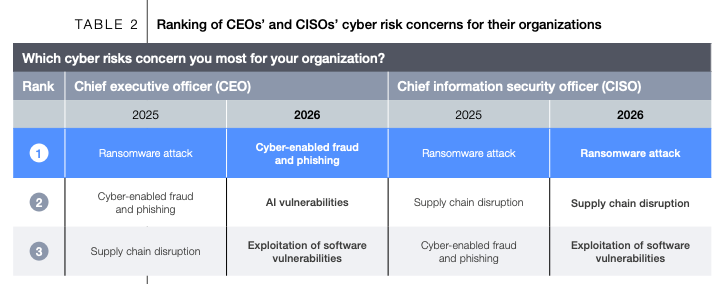
Cyber-enabled fraud and phishing have overtaken ransomware as CEOs’ top cybersecurity concern in 2026. According to the report, 73% of respondents said they, or someone close to them, were personally affected by cyber-enabled fraud last year.
This shift matters. Cyber risk is no longer limited to IT teams or organisations; it is impacting households, communities, and trust itself.
Exposure to cyber-enabled fraud and phishing / social engineering is highest in:
- Sub-Saharan Africa (82%)
- North America (79%)
- Latin America & the Caribbean (77%)
This reinforces the importance of security awareness, behavioral resilience, and empowering individuals to recognize and resist manipulation.
AI-Related Vulnerabilities Are Rising Fast
AI is reshaping the cyber threat landscape on both sides.
The report shows that 87% of leaders are most concerned about AI-related vulnerabilities, particularly:
- Data leaks
- Increasing sophistication of adversaries
- The technical security of the AI systems themselves
Interestingly, highly resilient organizations are already focused on AI-driven risks, while less resilient organizations remain primarily concerned with fraud and phishing. This highlights a growing maturity gap in how organizations anticipate and prepare for emerging threats.
AI hasn’t removed the human from cybersecurity, it has amplified the importance of human judgment, attention, and decision-making.
Cyber Inequity Is Widening, by Region and Sector
One of the most sobering findings is the widening gap in cyber resilience.
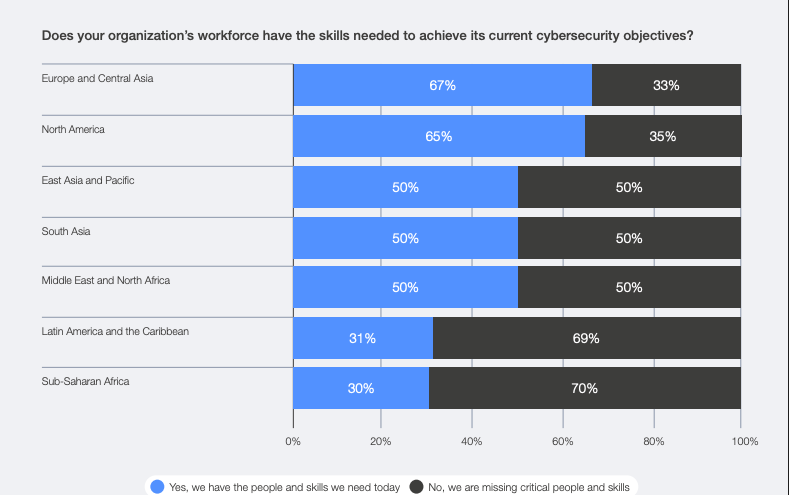
Confidence in national preparedness to respond to major cyber incidents is lowest in sub-Saharan Africa and Latin America. Organizations in these regions also report some of the weakest resilience levels, despite facing some of the highest exposure to cyber-enabled fraud.
Sectoral differences are equally pronounced:
- 37% of NGOs rate their cyber resilience as insufficient
- 23% of public-sector organizations report insufficient resilience
- Compared to 11% in the private sector
Skills shortages remain a critical constraint. Around 70% of CEOs in sub-Saharan Africa and 69% in Latin America & the Caribbean say they lack the people and skills needed to meet current cybersecurity objectives.
High risk combined with low capacity is a resilience gap organizations cannot afford to ignore.
Resilience Is Increasingly Collective
The strongest signal in the report is clear: the most resilient organizations are not acting alone.
They invest in:
- Collaboration with partners, peers, and governments
- Threat intelligence sharing
- Continuous development of people and skills
Cyber resilience today is less about isolated controls and more about shared responsibility, collective defense, and strong security culture.
This closely aligns with what we see at KnowBe4 every day: people remain the first and last line of defense.
Final Reflection
Contributing to the Global Cybersecurity Outlook 2026 reinforced a simple truth:
You can’t automate your way out of human vulnerability, but you can design systems, skills, and cultures that support better judgment.
As organizations plan for the year ahead, my hope is that this report serves not just as a benchmark, but as a prompt to invest more intentionally in people, culture, and resilience.
The 2026 Outlook confirms what many KnowBe4 customers already recognize: technology alone is not enough.
Building cyber resilience requires:
- Empowering employees to recognize manipulation
- Strengthening security culture and decision-making through AI empowered collaboration
- Investing in continuous awareness and skills development
KnowBe4 prepares the modern workforce by training both humans and AI agents to recognize and respond to security risks. Through this unified approach, KnowBe4 leads workforce trust management and defense strategies.