"Someone online shows a 'trick' that feels harmless at first. Then the community pulls you in. Everyone's doing it. It feels like skill, not crime."
A young person from South Africa, describing how their peers slide into cybercrime.
The above was a quote from a young South African responder to our survey on cybercrime perceptions. Notice what's missing: there is no villain, underground or dark web. Just a skill, a community and a sense of finally being good at something.
That is the picture that emerges from Crime or Career? Youth voices on cybercrime across the Global South, our new report developed in cooperation with the Global South Cyber Academies Network (CAN). In June 2026, we asked 238 young people and youth practitioners, mostly in South Africa and Latin America, what draws their peers toward cybercrime, who approaches them, and what would help. The answers point to something practical: prevention has to out-recruit the criminals, not only out-threaten them.
Download the full report: Crime or Career?
It Doesn't Look Like a Crime. It Looks Like a Job.
Recruitment rarely starts with "come commit a crime." It starts with an offer: flexible hours, quick money, "just helping out with a small task." Nearly four in five South African respondents (78%) and 56% in Latin America said involvement is presented to young people as a normal online job. Fake online job offers were the most-reported crime type in South Africa, at 82%.
And it happens where young people are already interacting. WhatsApp leads in both regions (72% in Latin America, 71% in South Africa). Beyond that, the platforms split: Telegram (61% vs 31%) and Discord (41% vs 23%) matter more in Latin America, while TikTok matters more in South Africa (53% vs 29%). Nothing at the top of the list is a hidden channel.
The offers escalate in steps. A respondent in El Salvador described being "offered small tasks with rewards, convinced these are legal things that won't harm them, and then the level of the rewards keeps going up." Two South African respondents described the same ladder in almost the same terms. By the time it is clearly a crime, there is something to hide.
Two Engines, and a Warning That Can Backfire
Much of the scientific research about young cyber offenders comes from the Global North, where researchers find curiosity, gaming and a need for recognition. Our respondents point to a second engine as well. In South Africa, survival or supporting a family (77%) and lack of jobs (74%) sit above every other driver. In Latin America, curiosity or testing skills leads at 64%, against 40% in South Africa. A prevention model built on only one engine may misfire on the other.
Status matters too. Asked how their community reacts when a young person suddenly has unexplained money online, 46% of South African respondents said the person is admired or treated as a role model, against 19% in Latin America. South Africans were also far more likely to describe offenders as "confident and bold" (41% vs 8%). Where crime is admired, a warning message isn't a deterrent. It can even become a badge.
When Belonging Turns Predatory
Not every network competing for that belonging is "just" after money. The loose online ecosystem known as "The Com" (short for "the community"), including groups such as "764", operates in the same gaming spaces and group chats where ordinary teenage life happens. It has been flagged by both the FBI and the UK's National Crime Agency for recruiting teenagers into social engineering and cyber fraud, and its subgroups have been linked to sextortion of minors and coercion into self-harm.
For a lonely 13-year-old, the entry point looks like any other online community: attention, status, someone finally taking an interest in what they can do. These networks weaponise the very aspiration this report is about. Belonging is offered first.
What Young People Are Asking For
When we asked what would help young people refuse cybercrime, jobs and income came first in every group: 91% in Latin America and 87% in South Africa. Fear of arrest was chosen by only about a third (35% and 32%).
Mentorship (54% vs 32%) and community support programmes (53% vs 32%) were far more sought in South Africa, which fits the picture of a pipeline that offers belonging as well as income.
Their free-text answers said it more plainly than any framework. A respondent in Panama: "the trick is for job offers to be more competitive than crime." One in the Western Cape: "give us digital literacy, because if you don't, desperation will keep teaching us to scam faster than your laws can catch up."
A note on what the data can and can't tell us: this is a perception survey with a self-selected sample, drawn largely from cyber academy students. It measures what young people believe about their own environment, not how often crime occurs, and it is not representative of youth in either region.
A Diversion of Potential, in Practice
One South African respondent asked us to "stop treating young people in cybercrime as either monsters to be locked away or victims with no agency," and to "start treating them as diversions of potential."
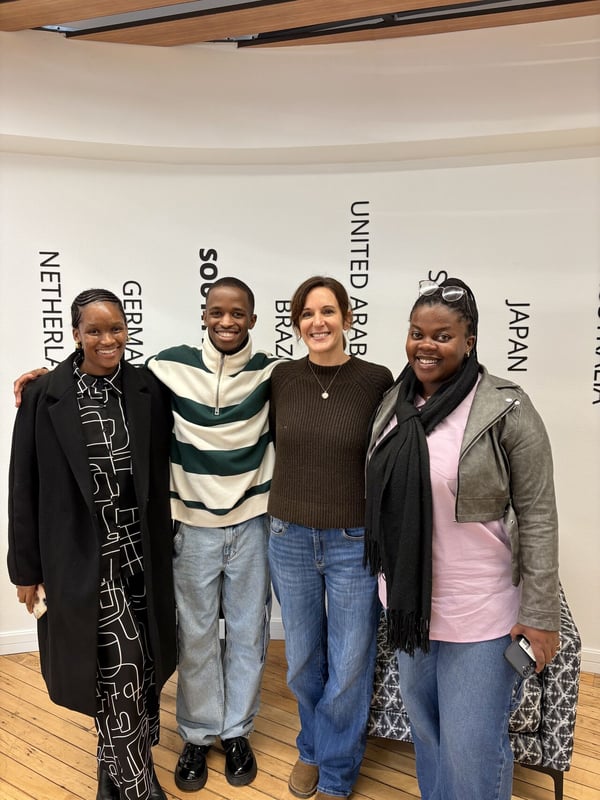
This research is an example of what that looks like. Relebohile Senatsi, Lebohang Selela, and Lwando Ntontela are graduates of the MiDO Academy, the cybersecurity academy KnowBe4 co-founded with the UK government. As KnowBe4 Africa interns, they didn't just support this project. They helped design the survey, shared it with their own networks, and wrote the first draft of the report, learning how academic research works along the way.
These are young people from communities where the "hustle" pipeline actively recruits. Here they were studying that exact pipeline, as paid professionals, on the defenders' side. That is the entire argument of this report.
It also scales. The Global South Cyber Academies Network (CAN) connects academies that see cybersecurity as a pathway out of poverty and a place of belonging, including MiDO and Absa in South Africa, IRSI in Latin America, Batuta in Mexico and CYSED in Nigeria. Brazil's government-backed Hackers do Bem offers free cybersecurity training to thousands of students.
What This Asks of the Rest of Us This Cybersecurity Awareness Month
The report's central finding is that the first contact is a job offer, not a crime. That makes this everyone's problem, and October is a good time to act on it. Our Cybersecurity Awareness Month resource kit has materials you can use right away.
If you're a parent or teacher: the pipeline starts younger than you think, in gaming spaces and group chats, and it looks like opportunity, not danger. The best defence is a young person who can recognise the pattern and a trusted adult who takes their tech curiosity seriously before someone online does. That's why KnowBe4 built CAPY, the Cyber Awareness Program for You: a free family hub with games for younger kids and straight-talking content for teens on scams, AI safety, and sextortion. No logins, no fees, no barriers.
If you're an employer: hire for skill, not pedigree. Internships, apprenticeships and entry routes that don't require a degree are the legitimate economy's answer to the fake job ad. Respondents asked for jobs and income above everything else (83 to 91%), so an entry-level opening is a prevention measure.
If you work in cybersecurity: back the academies. Every young person who enters the field through a MiDO, ABSA Academy, IRSI, CYSED or a Hackers do Bem is one the other talent programme doesn't get. Mentor a student, offer a placement, or share the report with your local academy.
Make Our Side the Better Offer
Both sides of the line are competing for this generation's talent and its sense of belonging. If the criminal pipeline recruits on opportunity, status and belonging, prevention has to compete on the same terms. Let's make sure our side makes the better offer.
[Download the full report, Crime or Career? Youth voices on cybercrime across the Global South →](https://www.knowbe4.com/hubfs/Crime-or-Career-Global%20South-Report_en-US.pdf)
Explore KnowBe4's free family cyber-safety hub, CAPY, and learn more about the Global South Cyber Academies Network.