Lead Analysts: Lucy Gee and Cameron Sweeney
With Grand Theft Auto 6 scheduled to launch on November 19, 2026, the 13-year wait for the most anticipated video game release of the decade is nearly over.
As legitimate marketing emails from Rockstar Games increase, video game fans are hyped. The anticipation is massive. However, this unprecedented excitement has created a perfect storm for cybercriminals.
Rockstar and its vast cult following have long fascinated threat actors, with the studio famously suffering massive network breaches and high-profile data leaks in recent years. Now, attackers are pivoting those established tactics directly toward the fanbase.
Threat actors are actively capitalizing on gamers' desperation, knowing that heightened anticipation reliably leads to lower critical thinking. By impersonating Rockstar in a massive, coordinated wave of phishing campaigns, they are weaponizing the promise of exclusive early access, fake "leaked" playable copies, or beta tester invitations to actively exploit both everyday consumers and corporate employees.
This playbook aligns directly with findings from KnowBe4’s Phishing Threat Trends Report Volume 8. That research showed planned calendar events drive the highest volume of lure-based attacks, with campaigns landing an average of 21.3 days before the actual date. On top of that, the lifespan of these planned campaigns more than doubled between 2022 and 2026, giving attackers plenty of time to tweak their angles and test out different lures.
The GTA 6 wave illustrates this dynamic in real time. Data obtained from KnowBe4 Defend shows a rapid, strategic escalation precisely within this pre-launch window:
Key Takeaways:
- While GTA-themed phishing accounted for just 0.005% of threats in September, general gaming-related phishing emails have since surged by 1,300% compared to the monthly average across the previous six months (March–August 2026).
- For the full week starting October 26th, 24 days before the release, GTA-related lures rapidly scaled to make up 9.6% of all phishing volume.
The First Wave: Mass-Market Noise
Predominantly, this surge is driven by high-volume, spray-and-pray commodity lures. These attacks focus on broad consumer appeal, casting a wide net across millions of inboxes in hopes of catching eager gamers off guard.
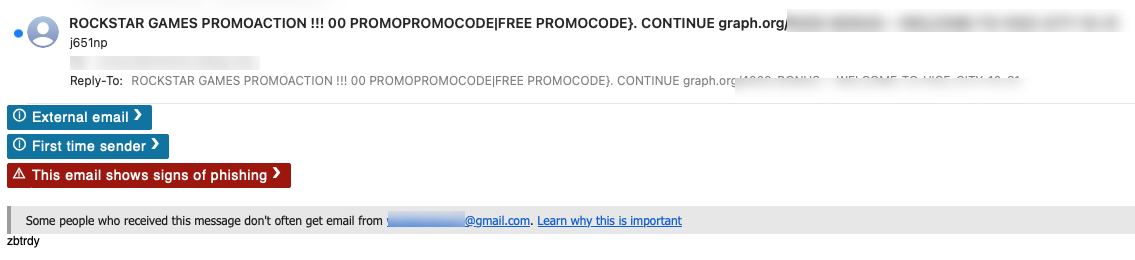
In the most widespread campaign, threat actors rely on a minimalist payload delivery to bypass security defenses: the email body is left completely blank, containing nothing more than an embedded link. By stripping away text entirely, the message circumvents basic natural language processing (NLP) filters and spam heuristics that search for suspicious gaming keywords.
To evade domain-reputation blocks, the campaign is heavily polymorphic, distributing waves of messages through constantly rotating webmail accounts with random subject lines so that blocking a single sender provides zero defense against the broader campaign.
Anatomy of the Attack
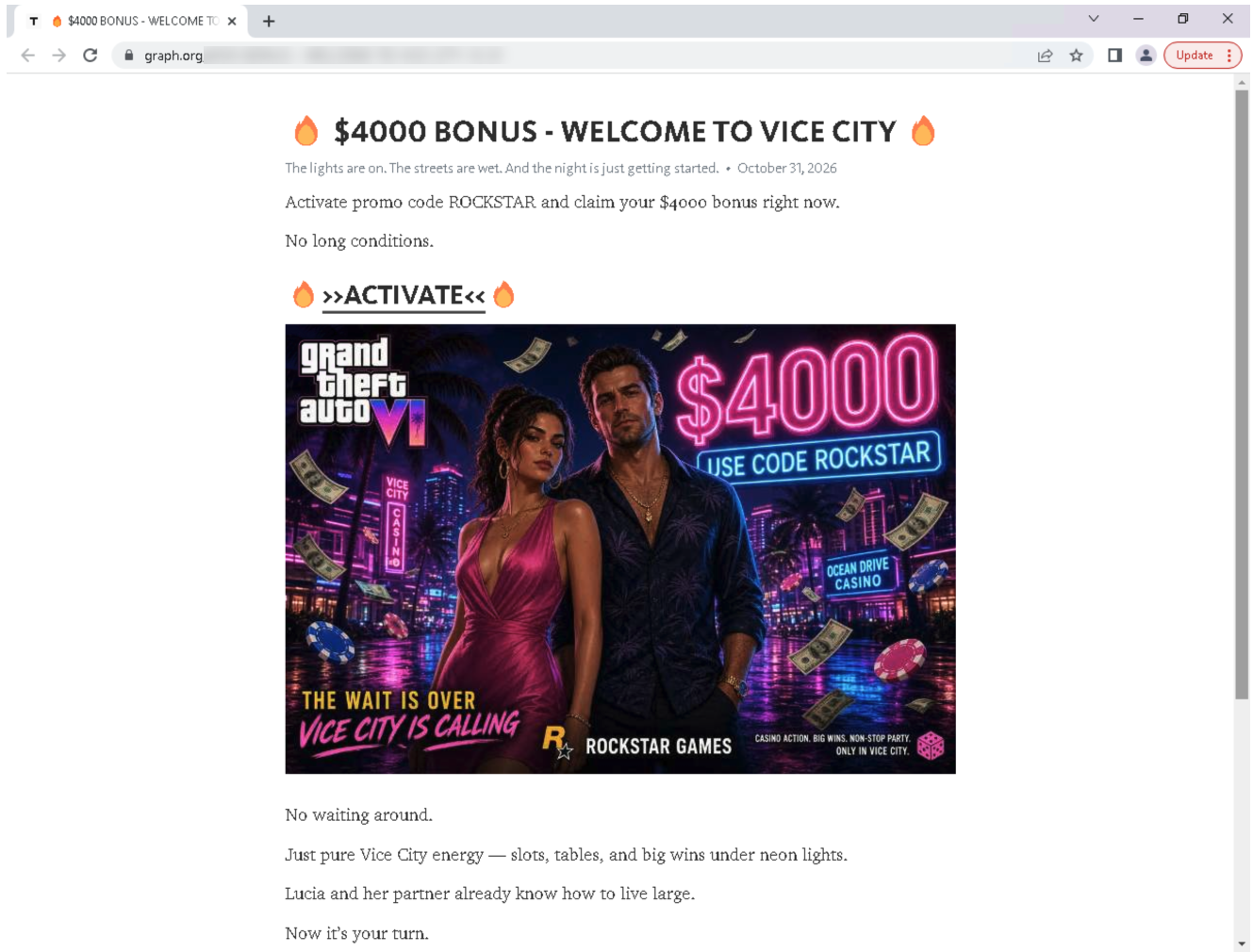
Clicking the link routes victims through a multi-stage lure that heavily borrows the official Grand Theft Auto 6 aesthetic. Initial landing pages are hosted on graph[.]org, which is Telegram’s lightweight, anonymous and login free publishing site. This allows attackers to host malicious content without registering their own infrastructure, making it easy to stand up pages that slip past filters, especially those looking at domain age.
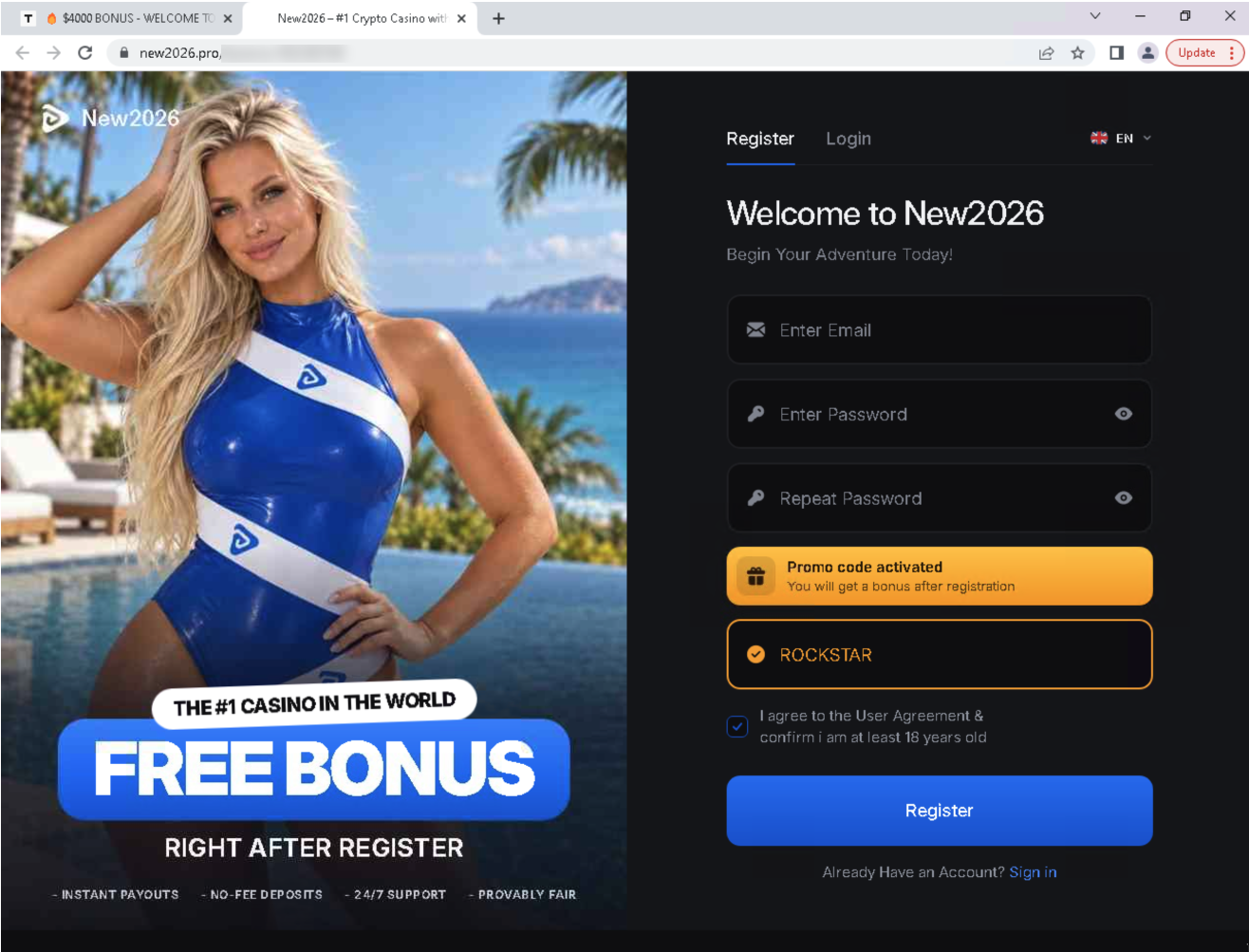
These pages feature Vice City neon styling, AI generated imagery of characters Lucia and Jason, and prominent Rockstar Games branding. The copy leans into themed phrasing like "The wait is over," "Vice City is calling," and promises of an exclusive "$4,000 bonus" using promo code ROCKSTAR.
Once a user clicks the activate prompt, they are redirected to a fraudulent online casino or crypto platform (such as new2026[.]pro) with the promo code pre-applied. The ultimate objective is dual-pronged monetization: tricking victims into registering an account to harvest passwords they likely recycle across gaming and personal platforms, while simultaneously siphoning payment card details or cryptocurrency deposits under the guise of claiming their GTA-themed welcome bonus. While these mass-market lures lack the sophistication needed to directly compromise enterprise networks, their relentless volume acts as a smokescreen, generating endless background noise for SOC teams.
Campaign Telemetry: Commodity Attack Distribution
- Top Targeted Regions: United States (47%), United Kingdom (35%), Germany (8%), France (5%), Rest of World (5%)
- Primary Target Verticals: Education (39%), Technology (35%), and Finance (15%)
- Campaign: 84 attacks on average per campaign, typically peaking on weekends and evenings.
While these commodity attacks lack sophistication, their sheer volume creates a smokescreen designed to overwhelm SOC teams. The real danger lies in what slips beneath the radar: advanced, targeted phishing campaigns, created to weaponize the intersection of personal interests and organizational trust.
The Second Wave: Targeting the Enterprise
Instead of directly impersonating Rockstar Games, these sophisticated attacks pose as employee benefits programs offering a "free Grand Theft Auto 6 Pre-Order" as a corporate perk. Because a free copy of a highly anticipated game is one of the few things that will convince an employee to check a work email on their days off, these campaigns are heavily weighted toward weekends, accounting for 83.2% of the attack volume. This strategy peaked over the October 31 to November 1 weekend, where GTA-related impersonations made up 42.4% of all phishing emails processed.
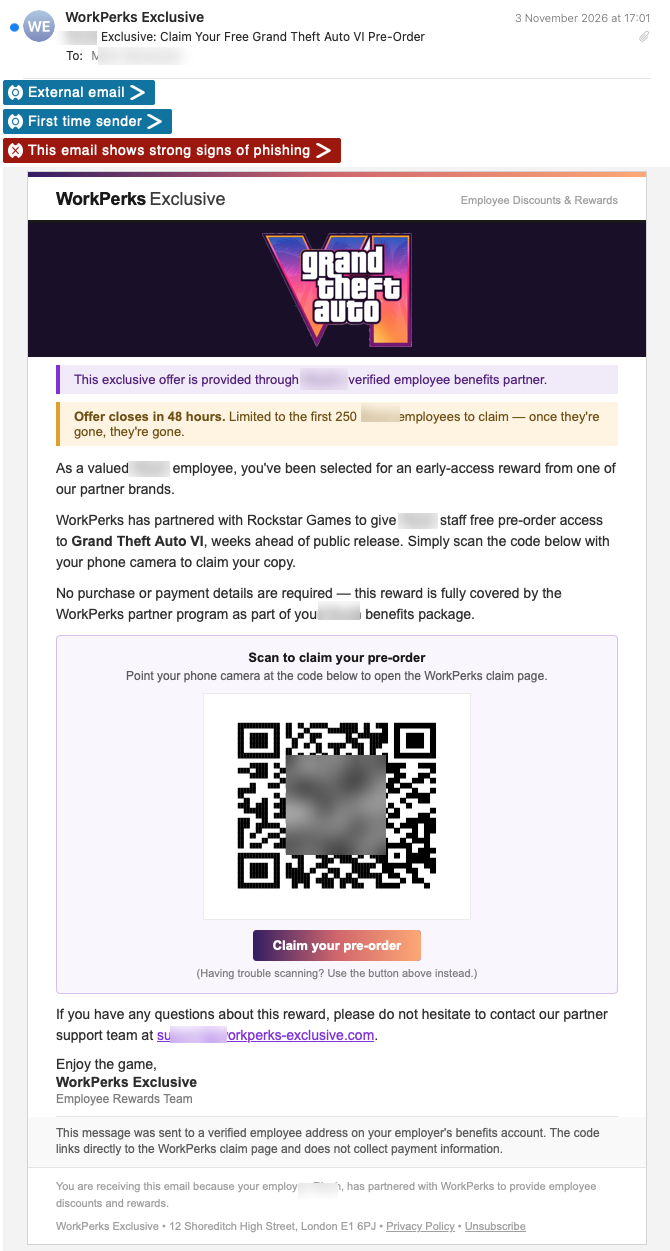
In this example, the attacker is combining psychological manipulation with technical evasion elements to ensure the attack lands in users’ inboxes and they’re motivated to click. Rather than impersonating Rockstar directly, which users might view with suspicion, the attacker routes the lure through a fake employee benefits program. Framing the game as a corporate perk carries significantly more weight than standard brand impersonation.
The attack also utilizes senses of urgency, claiming the offer closes in 48 hours and is strictly limited to the first 250 employees. This artificial urgency pushes the victim toward a fast, low-deliberation click. To make the attack look legitimate, the banner at the bottom of the email explicitly states that the message was sent to a verified address and does not collect payment information. This pre-answers the recipient's own suspicions, lowering their guard before they even question the email. By tying the lure directly to the real-world GTA 6 news cycle, the attack feels incredibly timely and relevant, blending seamlessly into the broader hype.
Technical Evasion
- Clean Authentication Bypass: The attackers use a genuinely owned, look-alike vendor domain rather than a spoofed one. As the domain is legitimately registered to the threat actor, SPF, DKIM, and DMARC pass cleanly.
- Unicode QR Codes: To evade traditional detection, the email uses a QR code rendered entirely out of text block characters (Unicode or HTML tables) rather than a standard image file, allowing it to bypass image QR scanners.
- Device Shifting: The ultimate goal of the QR code is to shift the attack off the protected corporate network. By forcing the victim to scan the code with their personal smartphone, the attacker completely bypasses corporate web filtering and Endpoint Detection and Response (EDR) controls.
These sophisticated phishing emails largely followed the same distribution as the commodity attacks. Campaign sizes, however, are much smaller averaging 20 attacks per campaign.
The Corporate Risk of Personal Lures
This blurring of lines between personal interests and professional environments is exactly what makes these attacks so dangerous. While a fake GTA 6 pre-order might initially look like a standard consumer scam aimed at stealing a personal credit card, the reality is far more severe: these campaigns are explicitly designed to compromise corporate assets. When an eager employee scans a malicious QR code on their unmanaged personal phone to claim a supposed "work perk," the resulting phishing page is rarely asking for their bank details. Instead, attackers are weaponizing this gaming hype to harvest credentials; turning a momentary lapse in personal judgment into a full-scale corporate breach.
Defending Against Hype-driven Attacks
As events like the launch of Grand Theft Auto 6 dominate headlines, attacks will continue to exploit the intersection of consumer excitement and corporate access. Threat actors targeted human psychology, not a software zero-day exploit. They identified an emotional blind spot of weekend relaxation and genuine excitement and used it to bypass both technical filters and common sense.
Protecting your organization against these hybrid threats requires a layered approach:
- Run Contextual Simulations: Train employees on non-traditional lure types. Especially fake HR perks, vendor discounts, real-world events, and corporate benefits delivered outside typical working hours.
- Validate Internal Communications: Establish a clear protocol for corporate benefits so employees know legitimate company perks will always appear on an internal intranet or HR portal, never via unsolicited external email links or urgent QR codes.
- Teach the "Device Shift" Red Flag: Educate staff that any work-related email asking them to pull out a personal smartphone to scan a QR code is a deliberate attempt to bypass security perimeter controls.
- Normalize Healthy Scrutiny: Remind teams that genuine corporate perks never demand urgency. If an offer says “limited to the first 250 employees,” it’s designed to shut down deliberate thinking.
- Harden Quishing Defenses: Ensure your email security layer can detect QR codes, including those rendered as Unicode characters or HTML tables, not just as image files.
When real-world hype peaks, critical thinking drops. Ensuring your workforce and security stack are prepared for both the high-volume noise and the targeted signal is the best defense against turning a pop-culture milestone into a network compromise.
Where KnowBe4 Can Help
These attacks rely on natural human emotions to trick your users. Excitement. A sense of urgency. Whether it’s an invitation to click a link or scan a QR code, your users need to be aware of the varied kinds of attacks bad actors are using.
The KnowBe4 Platform and its suite of tools provides the training your users need with the technology-based defenses to help keep attacks from even reaching the inbox.
AI-Native Security Awareness Training
Hype-based attacks need a quick response to ensure your users have the resources they need to spot them. KnowBe4’s suite of AI Defense Agents (AIDA) includes the capabilities to generate custom phishing simulation templates and whole modules in minutes, helping training admins respond to the newest threats.
KnowBe4 Defend: Real-Time Behavioral AI
KnowBe4 Defend uses behavioral AI and natural language processing to analyze email content and context to clearly flag when emails look suspicious. Defend adds a warning banner directly into the email before the recipient opens it. This interrupts the illusion of legitimacy, such as phishing attacks claiming to offer internal company benefits or perks.
PhishER Plus: Automated Threat Response
Once novel threats are identified, either through machine learning or human observation, PhishER Plus uses this information to keep future users from even seeing them. It automatically categorizes threats, provides immediate feedback to reporters, and enables one-click remediation across all mailboxes. Drawing intelligence from 13+ million global users and integrations with leading security platforms, PhishER Plus delivers unprecedented visibility while providing clear decision-making transparency.