Lead Analysts: Emily Hanlon, James Dyer
On October 29, 2026, cryptocurrency giant Binance lost approximately $6.34 billion in digital assets in under half an hour. The attack, attributed to the notorious Lazarus Group, stands as the largest crypto heist in history.
But how was an attack of this scale pulled off?
The entire compromise appeared to originate at the human and endpoint layer: a compromised engineer’s machine. Even in high-tech, cryptographically secured ecosystems, targeting humans and their admin permission remains the easiest way into an organisation.
Attacks of this magnitude trigger immediate fallout. In the days following the attack through November 2, KnowBe4 Threat Labs tracked a 128.9% surge in crypto currency impersonation threats. Cybercriminals specifically zeroed in on fake wallet transfers and withdrawal alerts.
The Aftershock: When the Phishing Fallout Hits Inboxes
Threat actors are notorious for riding the wave of major headlines. As we found for the Phishing Threat Trends Report Vol 8., attackers are 5.4 times faster responding to headlines in 2026 than they were in 2022. Whenever an event of this scale hits, KnowBe4 Threat Labs routinely tracks an immediate surge in secondary attacks that exploit the chaos. The sudden influx in cryptocurrency-related phishing is testament to this.
Fallout attacks following a major breach almost always fall across three main vectors:
Brand impersonation:
Impersonation was the main threat vector exploited by attackers following the Binance hijacking. In less than 48 hours, Binance rose from the 73rd most impersonated organization in Defend’s dataset to the 23rd.
High-profile attacks create prime conditions for cybercriminals. Threat actors exploit psychological fallout, specifically availability heuristics and salience bias. Constant media coverage pushes “Binance” to the front of everyone's minds and cuts through inbox noise. Even users who rarely check their accounts suddenly zero in on any message bearing the breached brand’s name. Fear does the rest: worried that their own accounts are compromised, recipients act on impulse. Scammers can ruthlessly capitalize on this anxiety, knowing urgency and fear crush skepticism.
Example:
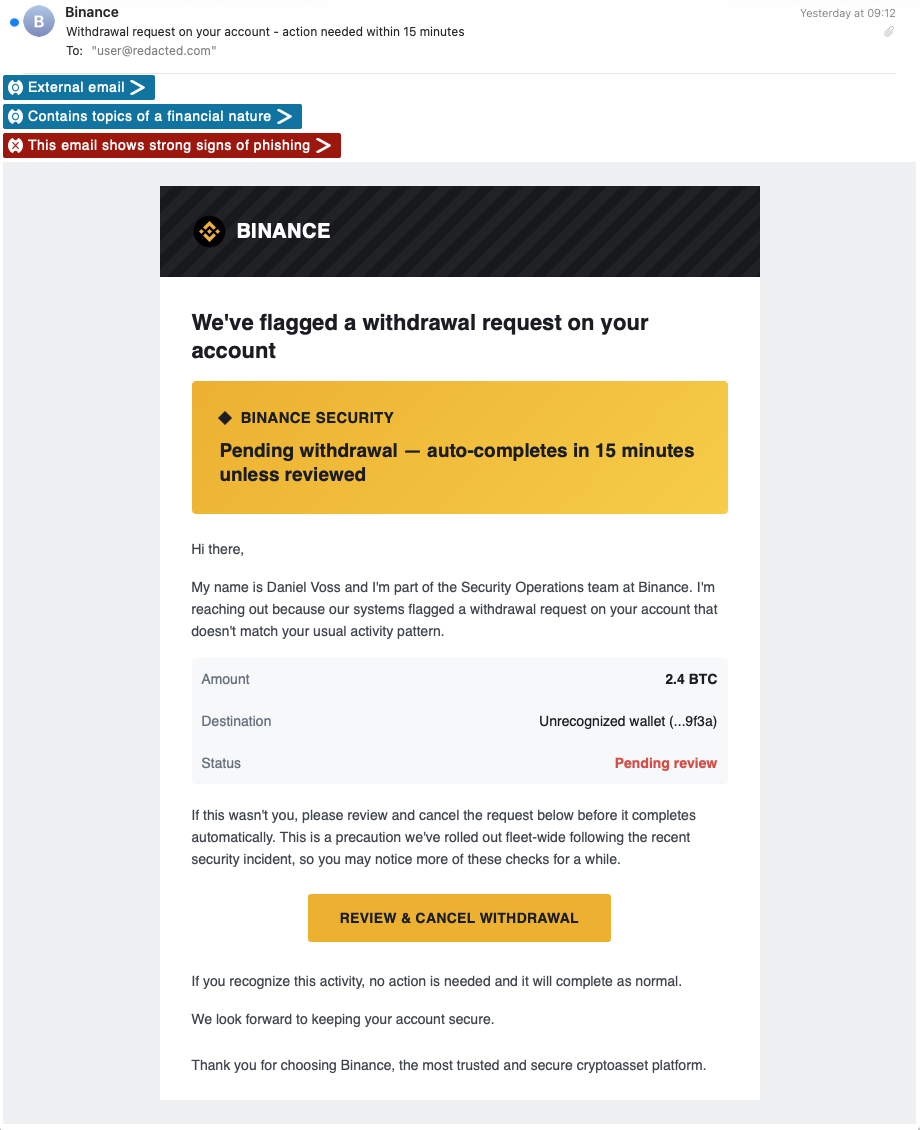
This phish rolled out mainly to UK and U.S. inboxes, deliberately using the same font colors and styling as typical Binance mail. The attackers likely leveraged generative AI to mimic Binance’s standard email templates. By exploiting brand familiarity, they amplify the urgency and fear that the recipient's account is part of the compromise. The email included embedded hidden characters throughout the text, disrupting linguistic-based detection of Binance brand impersonation. When users click the link, they’re prompted to “login” to authorize the cancelled request, inevitably handing credentials over. This phish deployed only 13 hours after the initial attack.
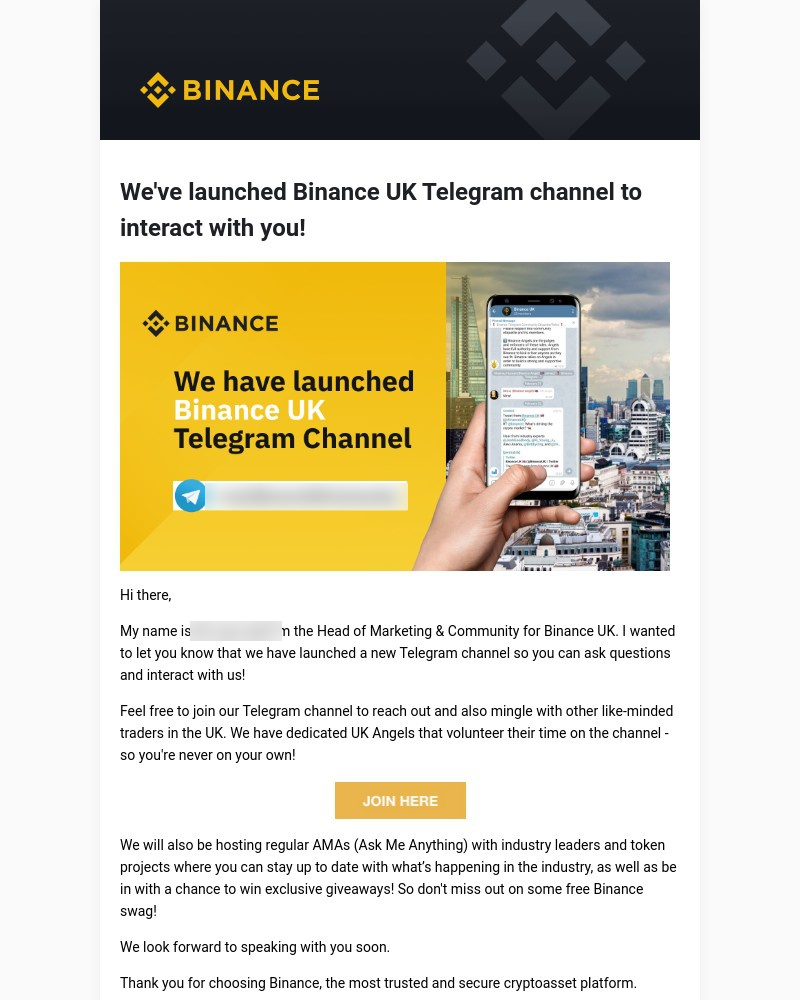
Shown below is a legitimate email from Binance. The phishing campaign accurately replicates this template that end users are unlikely to spot any visual indicators of compromise:
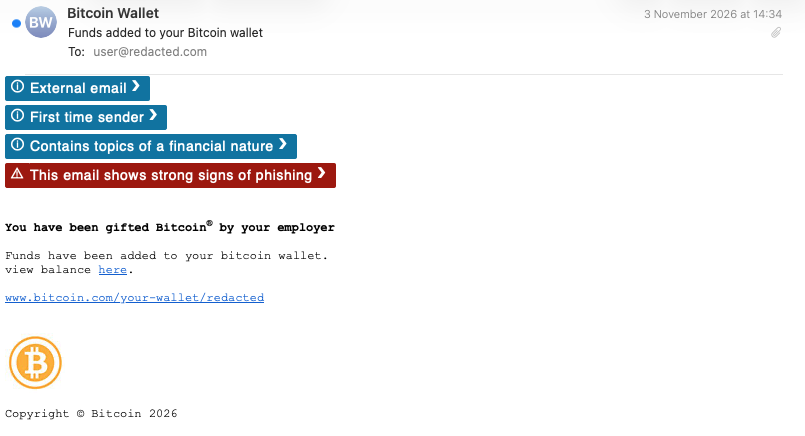
These impersonation lures extended beyond just “Binance.” In fact, 8.9% of all phishing attacks on Friday, October 30, contained the word “bitcoin” in the email, primarily in the subject and display name.
Top subject lines:
- “Bitcoin Deposit Confirmation”
- “<name> Update Your Bitcoin Details Now”
- “Funds added to your Bitcoin wallet”
- “Secure your Bitcoin wallet fast”
Recovery scams
High-profile exchange breaches reliably trigger a predatory second wave: recovery scams. Cybercriminals understand that when news breaks, users scramble in fear. Fraudsters capitalize on this chaos in two ways: first, by blasting fake security alerts that prompt users to "secure" or "re-verify" their wallets, a common credential harvesting lure, and second, by promising users who have lost assets reimbursement or recovery for a fee.
This triggers a cruel cycle of double-victimization. Desperate to recover lost savings, panicked users lower their guard for spoofed "claims portals" and end up signing away whatever assets they had left. Recognizing this pattern is critical: once an attack goes public, assume any unsolicited outreach, no matter how verified or urgent it looks, is an attacker trying to profit from the wreckage.
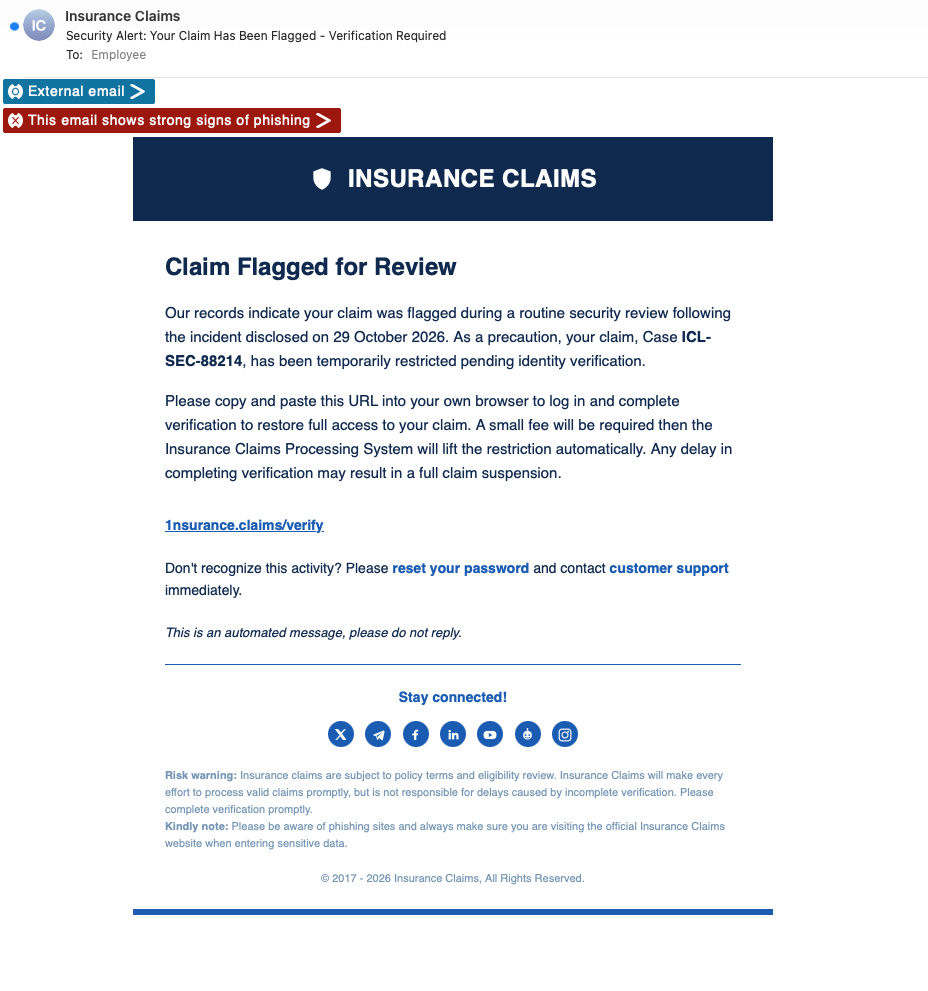
This campaign has similarly tried to match Binance's branding, pretending to come from the company’s internal insurance or risk division. To slip past automated link scanners, the attackers drop a plain-text URL directly into the body and instruct the recipient to copy and paste it into their browser. The address mimics a legitimate Binance domain at first glance, but swaps the "i" for a "1" and uses a .net extension. Once pasted, the link requests the user pay a small upfront fee to unlock ‘security advice’.
Spear Phishing
Right after a major exchange breach, phishing gets much smarter. Attackers drop the generic spray-and-pray emails and start using the actual details of the incident as bait, knowing everyone is glued to the news waiting for updates.
One of the sharpest vectors targets third-party partners and contractors. Posing as internal incident response teams or forensic investigators, the attackers send emails dangling "Confidential Forensic Reports," "Urgent IoC Feeds," or "Emergency Security Questionnaires." Tucked inside is usually a password-protected ZIP, a poisoned PDF, or a malicious cloud link. The moment an engineer opens it, malware drops quietly onto the machine—setting up a foothold inside partner networks using the exact same playbook that started the breach in the first place.
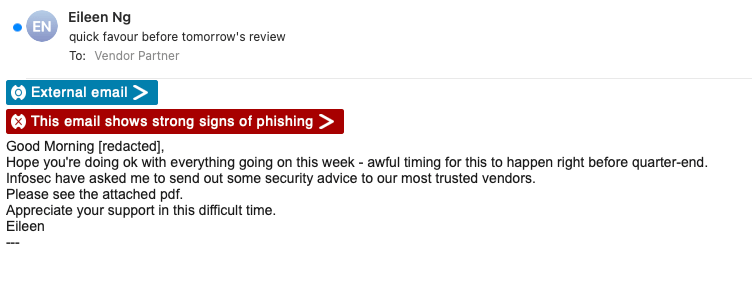
This phish relied on techniques that work even against alert, well-trained employees. Attackers increasingly go beyond simply avoiding detection and instead they actively limit telemetry from the email itself so detection engines view the emails as “safe.” This email used CEO impersonation to exploit a user’s natural reluctance to question a senior leader, using a spoofed authority figure alongside real organizational stress, pressures staff into skipping normal verification for a payment, access request, or file. This email used PDF-based malware delivery which doesn't require clicking a link inside the document: a crafted PDF can run embedded scripts or exploit the reader itself the moment it's opened.
How Has this Impacted Different Countries and Industries?
In the days following the finance hit, the U.S. was the biggest target for cryptocurrency phish, taking nearly 70% of hits, with the UK behind holding 18%.
Top industry proportions:
| Industry | Percentage of the cryptocurrency phish received by industry |
|---|---|
| Insurance | 32.4% |
| Finance | 26.9% |
| Law | 19.4% |
| Education | 12.9% |
Dominant attack techniques across industry:
📑 Insurance - 32.4%
They have an average of nearly three tactics per email, aimed to overwhelm both traditional defenses and the user. They blend executive impersonation, BEC, fear-driven extortion, and heavier technical tricks into multi-layered traps designed to slip past defenses. This is a typically aggressive and chaotic technique.
💸 Finance - 26.9%
Finance is completely dominated by brand impersonation, where scammers clone recognizable banking portals and software alerts to harvest login credentials. Because finance teams are conditioned to click through security dashboards and transaction notices all day, attackers simply mimic those routine tools instead of reinventing the wheel.
📜 Law - 19.4%
Legal practices see a lethal mix of personal extortion and high-stakes corporate wire fraud. Attackers know that attorneys deal in tight confidentiality and massive settlement transfers, so they skip fake login pages and go straight for the jugular: personal blackmail or hijacking actual payment chains. It’s less about mimicking big software brands and more about exploiting human panic and professional reputation
🔢 Education - 8.9%
The threat landscape here is about as blunt and generic as it gets, heavily skewed toward automated, copy-paste sextortion blasts. Scammers aren’t burning precious zero-days or drafting elaborate ruses — they're playing an untargeted numbers game across thousands of easily accessible university inboxes.
How To Defend Your Organization
- Treat all "recovery" and "refund" outreach as a scam: Real exchanges and insurance divisions will never reach out unsolicited, ask you to pay an upfront fee for "investigation advice," or demand you connect your wallet to an external claims portal. Once an attack goes public, assume any offer to restore lost funds is a predatory second-wave trap.
- Never verify accounts through links or copied URLs: Following a massive breach, scammers flood inboxes with fake security alerts using lookalike domains and plain-text URLs to bypass automated scanners. If you receive a warning about unauthorized activity, open a new browser window and navigate directly to your bookmarked login page.
- Confirm urgent executive demands: Threat actors weaponize organizational stress and executive authority to rush staff into skipping protocol. If an email claims to come from a senior leader demanding urgent action, wire transfers, or sensitive file downloads, verify it through a separate channel, rather than replying to the email.
Remember, just because it looks real doesn’t mean it is. When major headlines break, always expect the phishing aftershocks to follow.